A useful plan, ready to keep. Use the tables and final checklist below, or print the guide for your kitchen or home notes.
The short answer
Cooked chicken lasts three to four days in the refrigerator under USDA guidance, provided it was chilled promptly and kept at 40°F (4°C) or below. That advice applies to chicken you know was stored and handled correctly. A retailer's instructions or a prepared dish's other ingredients may require a shorter period.
Start counting from cooking or the relevant preparation date. Moving leftovers into a new box, mixing them into a salad or reheating them does not make their previous storage history disappear. Put the date on the container while you still know it.
The storage decision table
| Situation | Useful rule | Action |
|---|---|---|
| Promptly chilled cooked chicken | Refrigerate at 40°F or below; use within 3 to 4 days. | Label the date and plan a meal. |
| Left out after cooking | Refrigerate within 2 hours, or within 1 hour above 90°F (32°C). | Discard food that exceeded the limit. |
| You will not eat it in the fridge window | Freeze safely handled leftovers within 3 to 4 days. | Prefer early freezing in meal-sized portions. |
| Reheating leftovers | Heat to 165°F (74°C). | Check the food with a thermometer. |
The clock includes serving and travel time, not only the time after you remember to put the food away. A chicken platter sitting on the table through a long gathering needs the same attention as a pan on the counter.
Chill it without waiting for a whole bird to go cold
USDA advises dividing large amounts of food into shallow containers for rapid chilling. Hot food can go directly into the refrigerator, or be rapidly chilled in an ice or cold-water bath first. Do not leave a large bird on the worktop until it feels completely cold.
Separate the cooked portions with clean utensils and package them in amounts you will use. Keep cooked chicken away from raw poultry and its juices. An airtight or covered container helps protect it from contamination and drying; it cannot repair an earlier lapse in safe handling.
For a roast, plan the leftovers before serving. Set aside the amount you intend to chill, label its cooking date and check where it will fit. A shallow lunch portion is easier to cool and retrieve than a deep box containing the whole remaining meal.
Make the fridge temperature visible
Check the refrigerator with an appliance thermometer. The dial setting is not a direct reading of the temperature beside the food. If a fridge is crowded, warm or failing, “three days in the fridge” is not enough information to establish safety.
Keep leftovers where you can find them and raw poultry where it cannot drip onto ready-to-eat food. Avoid repeatedly taking out a large container for small servings. Portioning reduces the number of times the remaining food is handled and warms during preparation.
If you discover the refrigerator has been above its safe temperature, use the relevant food-safety advice for that incident. Do not simply shorten the date by a day and assume the problem is solved.
Freeze for a planned future meal
If the chicken will not be eaten within the refrigerated window, freeze it while it is still safely handled. Waiting until the last possible moment makes it easier to lose track. Choose containers or freezer bags designed for food and protect the contents from air.
USDA's general leftovers guidance gives three to four months in the freezer for quality, while food kept continuously at 0°F (−18°C) remains safe indefinitely. A quality recommendation assumes the food was safe before freezing and the freezer stayed cold. Write the original cooking date and the freezing date on the label.
For a lunch, note whether the portion is plain chicken or a complete dish. The preparation and storage rules for salad ingredients, dressings, rice or other additions still apply. Link the portion to a specific entry in your meal plan so you use it rather than buying another duplicate ingredient.
Reheat thoroughly, or serve cold after safe storage
Properly stored cooked chicken can be eaten cold within its storage window. If reheating, USDA advises reaching 165°F (74°C). Check thicker pieces and the centre of mixed dishes. In a microwave, stir or rotate as appropriate, allow the recommended standing time and check more than one place.
Do not use a fixed reheating time from a different portion or appliance as proof. A small sliced portion and a dense casserole heat differently. If a dish's recipe gives a temperature or another safety requirement, meet that too.
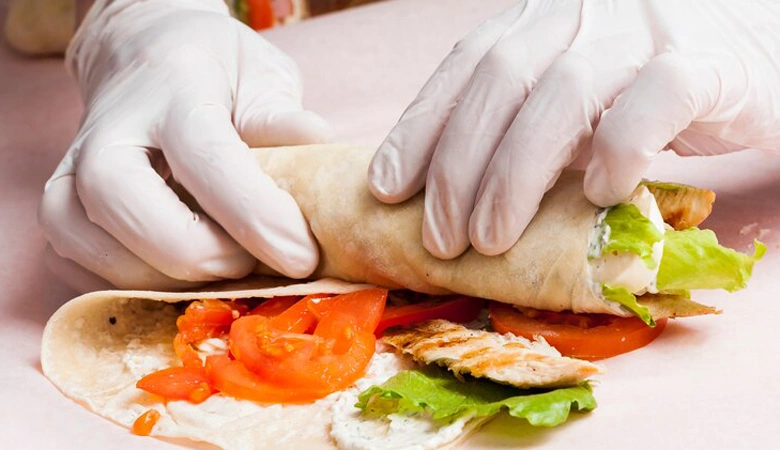
Only warm what you plan to eat. Repeatedly reheating the same family-sized container makes its handling history harder to track. For a club-style wrap, chilled cooked poultry can be a useful ingredient, but keep the completed wrap refrigerated and follow safe packed-lunch guidance.
Smell, slime and the unknown-date container
Can I rely on smell?
No. An unpleasant smell or obvious spoilage is a reason to discard chicken, but a normal smell does not prove the food is safe. Date, chilling and temperature matter.
Can I boil chicken that sat out overnight?
Do not use cooking as a rescue for unsafe storage. Discard it rather than turning it into a soup.
What if I cannot remember when it was cooked?
A guess is a weak basis for deciding. Label the next batch at preparation time. If the current food's history is uncertain, do not taste it to find out.
Does a rotisserie chicken get a different clock?
USDA includes ready-prepared chicken in its handling guidance. Bring it home promptly and follow any retailer instructions. Time spent waiting in a car or on a counter still matters.
A fridge-to-dinner checklist
- Cooking or purchase date recorded.
- Chilled within the applicable time limit.
- Stored at 40°F (4°C) or below.
- Used within the 3 to 4 day US guidance or any shorter applicable instruction.
- Frozen earlier if the meal plan changed.
- Reheated to 165°F (74°C) when serving hot.
One dated container and one planned meal will do more for your leftovers than a row of identical boxes whose contents no one remembers.
Sources
A LITTLE MORE FROM NANCY
Nancy
Find something good to cook, get a small garden started or pick up a useful idea for your home.
Meet Nancy