
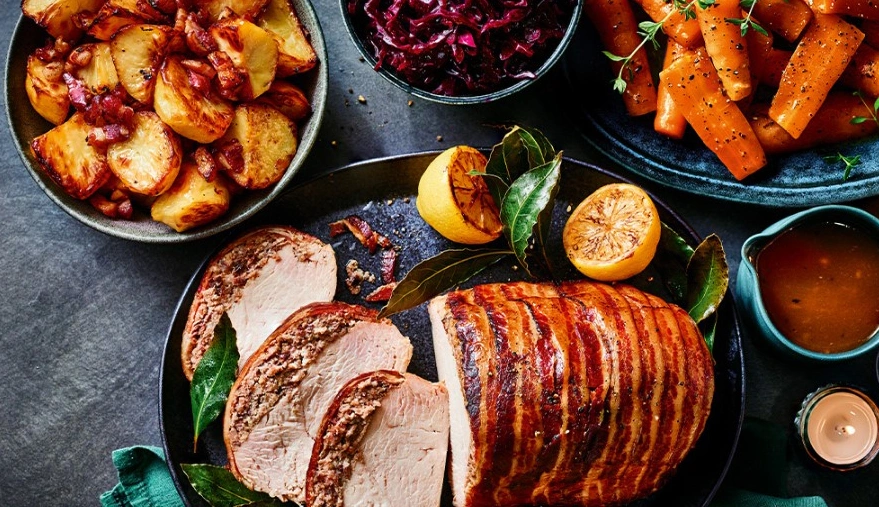
Start with your guest count, serving time and actual equipment. Then choose a menu that fits. A smaller dinner with a clear plan is a perfectly good Christmas dinner, whether your main is turkey, another roast or a vegetarian dish.
Choose a menu that fits your kitchen
Ask guests about allergies and dietary requirements before fixing the main. Decide which dishes everyone can share and where a separate dish is needed. Check ingredients in bought gravy, stuffing and desserts as carefully as the main food.
Choose the part of the meal you most want to cook. Use convenient bought components elsewhere if they help. There is little benefit in making every sauce yourself when you would rather spend that time with guests.
| Part of the meal | Possible choice | Planning question |
|---|---|---|
| Main | A roast or vegetarian centrepiece | What dish, shelf space and exact method does it need? |
| Potatoes | Roast potatoes or mash | Does the oven have room, or would a hob method suit better? |
| Vegetables | Two vegetables your guests enjoy | Can one use a hob pan rather than another oven tray? |
| Sauce | Gravy or a suitable alternative | Which pan, ingredients and serving jug will it use? |
| Dessert | A bought dessert or a recipe prepared appropriately ahead | Does it need fridge space or last-minute heating? |
This is an equipment example, not a complete recipe or a promise that every combination works. Put the actual recipes beside it before settling the menu.
Make an oven worksheet, not just a to-do list
For each dish, write its temperature, approximate cooking duration, tray dimensions, shelf position and any recipe-approved resting or holding instructions. Put the empty trays in the cold oven to see what fits. A second tray that technically squeezes in may still obstruct the space your equipment instructions require.
Look for clashes. If two dishes need incompatible temperatures at the same time, change a dish, use another suitable appliance or find a complete method that handles the combination. Do not average the temperatures and hope the main is safe.
A vegetarian main deserves a proper place in this plan. It should not become something squeezed in after everyone else's food is ready. Also reserve suitable clean utensils and serving dishes where separation matters.
Work backwards from the time you want to eat
- Write the serving time and who will carve, plate or bring dishes to the table.
- Place each recipe's finishing tasks before that time, including any genuine resting period.
- Place the cooking steps before the finishing tasks, using the actual recipes and equipment.
- Allow time to check doneness and resolve a delay. An approximate finish time is not a safety test.
- Move non-cooking jobs out of the busy stretch: lay the table, find serving spoons and clear the draining board earlier.
Suppose you intend to serve at 2 pm. You do not yet know when the main must enter the oven. That comes from its weight, preparation, cooking instructions and required checks. Start with those facts, rather than an internet schedule for someone else's bird.
Give the shopping list a storage plan
Add together ingredients that appear in several dishes. Butter, onions and milk may occur on more than one recipe list. Check what you already own, then list what remains by cupboard, fridge and freezer.
Before buying the main, confirm that it fits the fridge or freezer and that you have time to defrost it safely if required. Follow the product's defrosting instructions and the FSA's chilling and defrosting advice. Countertop thawing is not a shortcut to put into the schedule.
Check the main and deal with leftovers
Use a clean food thermometer and the appropriate product and safety instructions. The FSA gives 75°C for 30 seconds as one centre temperature-and-time combination for food that needs thorough cooking, including poultry. An oven temperature or browned surface is not that measurement.
Set aside shallow containers and fridge space before guests arrive. The FSA advises cooling and refrigerating leftovers within two hours, eating them within 48 hours or freezing them, and reheating only once. Follow any stricter food-specific guidance, including for rice.
Write the next day's meal into the plan while you know what is left. Our weekly dinner planner can help, while the finger-food guide is useful if your gathering is a buffet rather than a sit-down meal.
A LITTLE MORE FROM NANCY
Nancy
Find something good to cook, get a small garden started or pick up a useful idea for your home.
Meet Nancy
